Tracing the vertical journey
Embark on an adventure through time and discover the ancient origins of rock climbing. While early humans climbed out of necessity, not for sport, their acts laid the foundation for what would become a global community. Join us as we explore the natural instinct to ascend and how it has shaped our shared history.
Climbing from the dawn of time
From the earliest cave dwellers seeking shelter to ancient civilizations scaling mountains for resources, humanity's relationship with climbing is deeply ingrained. This natural impulse, born of survival and exploration, forms the bedrock of modern rock climbing. It's a testament to our innate connection to the vertical world.
From necessity to recreation
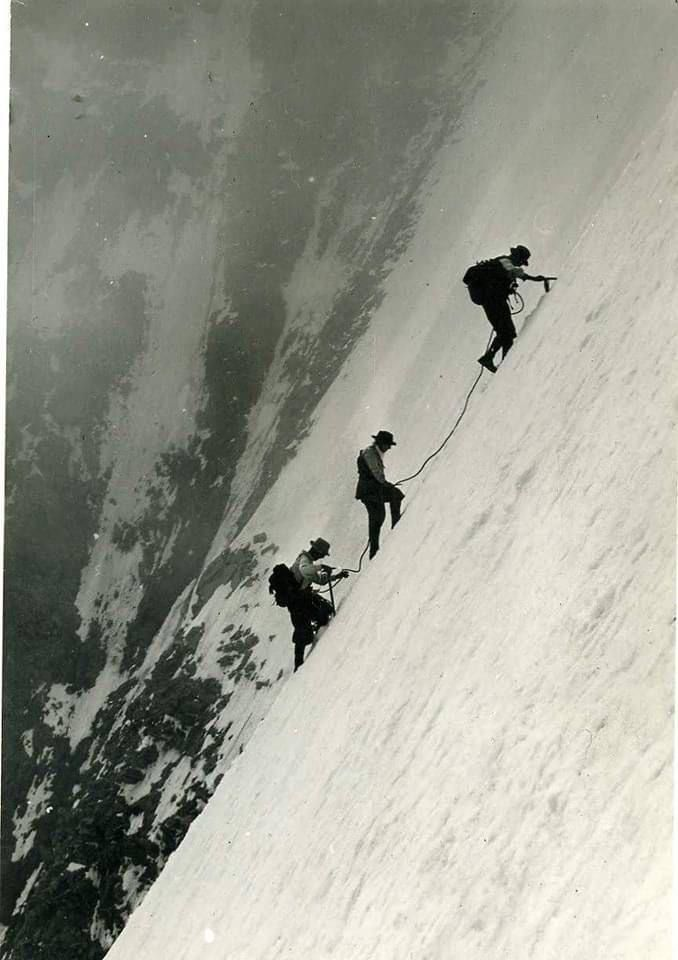
The transition of climbing from a purely functional activity to a recreational and sporting pursuit is a fascinating chapter in human history. Witness how early mountaineers, driven by curiosity and a thirst for adventure, began to formalize techniques and equipment, paving the way for the sport we know and love today.

The evolution of a community
Rock climbing has evolved significantly, not just in techniques and gear, but also as a vibrant and supportive community. Climbing has become, from solitary ascents to a global network of enthusiasts sharing challenges, achievements, and a deep respect for nature.
From the Beginning
Rock climbing is an ancient skill used since the beginning of time out of necessity to hunt prey, survival, and to climb to shelter. Now days, climbing is more of a hobby and says a lot about how far we have evolved as humans.

Driven by Survival
Wilkinson, F, from Rock climbing states that" There is ample evidence that ancient and pre-modern cultures across the globe found reasons to venture onto what today would be considered 'technical terrain.” In Mustang, Nepal, archeologists discovered a complex series of burial caves that can only be reached by climbing the faces of imposing vertical cliffs. The American Southwest is riddled with evidence of native tribes living among the mesa cliffs of the region. Most ancient people probably climbed for safety.
Three places are credited as the birthplaces of modern recreational climbing: the Peak and Lake Districts of England, the Elbe Sandstone region of Southeastern Germany, and the Dolomites of Northern Italy."
People mostly climbed out of necessity probably for shelter, food, and water.

Early Hobbiests
Paul from Rock Climbing Central gives examples as how climbing slowly started to become a popularized sport through new inventions to aid climbers,
“By the first decade of the 20th century, pioneers were experimenting with first-generation climbing inventions such as steel carabiners and soft iron ring pitons. Throughout the first decades of the 20th century, the techniques and knowledge developed in early hotspots slowly traveled throughout North America, Europe, and elsewhere. This early era culminated in the 1930s, when many watershed technical climbs were done across Europe and North America, from the first ascent of Ship Rock in New Mexico and Devils Tower in Wyoming, to the Walker Spur of the Grandes Jorasses in the French Alps.

Climbing Community
Paul from Rock Climbing Central continues to explain how,"Within the last 50 years, rock climbing has rapidly increased in popularity due to many indoor rock-climbing gyms opening throughout the world. With the increase of popularity comes increased focus on competitions, which in turn increases the popularity. The International Olympic Committee has also introduced sport climbing to the Tokyo 2020 Olympic Games with the three disciplines Bouldering, Lead Climbing, and Speed climbing counting towards an overall score. What’s important to remember here is that equipment and materials such as climbing shoes and chalk weren’t used or invented until the mid 1900s, so when you see a climb rating before this, these haven’t been used"! Climbing has started to become increasingly popular among those that love outdoor activity and physical challenge.
Story of the first documented Climbers:
Pilson, G, the Climbing Guy gives a great story example of early climbing as the first time it was documented as climbing slowly becoming a hobby:
"One of the first documented rock climber, however, did not climb for fun or fame, but rather to fulfil a royal command. In 1492, Antoine de Ville ascended Mont Inaccessible, a 300-meter-tall rocky tower on Mont Aiguille near Grenoble, France on orders from King Charles VIII of France. Using techniques originally developed for the sieging of castles during wartime, de Ville used ladders and ropes to make it to Inaccessible summit where they stayed for six days and erected three crosses to prove their ascent, which would not be repeated until 1834. Some of the wealthy aristocrats of 18th century Britain started setting off on holidays to the Alps to enjoy the fresh, mountain air. Some of these aristocrats quickly found that hanging out at chalets on the valley floor just wasn’t exciting enough and started to search for something new to whet their appetite. One of these aristocrats, Horace-Bénédict de Saussure, set out on an adventure and climb the stunning Mont Blanc. Despite his best efforts, however, de Saussure was unable to climb Mont Blanc on his own, so he offered a public reward in 1760 to anyone who could help him get to the top. De Saussure’s prize money went unclaimed for more than 25 years until a 26-year-old crystal hunter named Jacques Balmat came onto the scene. Despite his position as a porter, Balmat was essential to the duo’s eventual success and summit of the peak in 1786, which was done without ropes or ice axes. After his first summit of the mountain, Balmat then helped de Saussure climb to the top of Mont Blanc just one year later. For these feats, King Victor Amadeus III gave Balmat the honorary title, du Mont Blanc. Although his achievement often goes unrecognized in today’s climbing world, Balmat’s 1786 climb of Mont Blanc truly set the stage for the golden age of mountaineering that followed. After other great climbing attempts like this, climbing became popularized as a sport for glory and power as it spread across the nation.
There has been significant improvements from the first ever climbing gear to now.
Here is a simple Rock-Climbing Timeline to go by:
400BC: watercolor found in China details men climbing rocks
1100s: evidence shows Native Americans that lived in Southwest Anasazi climbed cliffs in Chicago Canyon
1492: Mont Aiguille was climbed by a servant of Charles VIII named Antoine de Ville.
1695: Martin of Scotland climbs St. Kilda with the aid of ropes
1786: Frenchmen named Michael Gabriel Piccard and Jacques Balmat were the first to ascend to the summit of Mont Blanc which is the highest mountain in the Alps.
1800s: rock climbing was finally being recognized as a recreational sport, especially in European countries.
1869: John Muir free solos the first ascent of Cathedral Peak in Tuolumne Meadows while wearing hiking boots
1875: George Anderson makes the first ascent of Half Dome in Yosemite National Park without the benefit of modern climbing gear or techniques
1910: The design of a piton was changed by Hans Fiechtl after he replaced the attached ring with an eye in the body of the piton. In the same year, the first steel carabiner was designed specifically for climbing by Otto Herzog
1927: the first rock drill and expansion bolt was designed and sold by Laurent Grivel. The same year, the development of the modern “Stopper” was first experimented by Fred Pigott.
1980: the first-ever “sticky rubber” shoe is released by Boreal that is used most commonly today
2007: in Frankfurt, Germany by 57 Federations. The Association Générale des Fédérations Internationales de Sports [AGFIS) [French for Genera Association of International Sports Federation] and the International World Games Association (IGWA) accepted the IFSC into later that year. By being accepted by the IGWA, competition climbing was confirmed to be included in the Kaoshiung World Games in 2009
2020: Tokyo 2020 Olympics, sport climbing was introduced as a combined event featuring all three disciplines — speed, bouldering, and lead. The first-time climbing has been recognized as an Olympic sport.
Extra fun facts:
Wilkinson F. from Rock climbing: from ancient practice to Olympic sport explains the origin of bouldering and the use of chalk:
“Bouldering, climbing without a rope on small cliffs and boulders where it is possible to land relatively safely, first evolved on the boulders of Fontainebleau outside of Paris in the mid-century. Because bouldering allows the climber to practice intricate movements unencumbered by a rope or safety concerns, it is the premier venue for pushing the absolute limits of free climbing. In the 1950 and 60s, an eccentric Air Force officer-cum-mathematician named John Gill living in Colorado Springs, Colorado, began to use basic gymnastics exercises and training principles to train for bouldering. He also used magnesium carbonate chalk favored by gymnasts to keep his hands from sweating while he climbed—both innovations that are universally embraced today".
It's super cool to think about these historians and how far we have come since climbing out of survival to participating in it as a hobby.
Sources used above:
Anderson, S. (2024, July 4). Earliest-Known rock climb stood unrepeated for centuries.
Explorersweb. https://explorersweb.com/mont-aiguille-first-ascent-1492/
Pilson, G. (2019, May 4). History of rock climbing. The Climbing Guy.
Paul. (2020, April 22). The history of rock climbing. Rock Climbing Central.
https://rockclimbingcentral.com/the-history-of-rock-climbing/
Wilkinson, F. (2019, March 14). Rock climbing: from ancient practice to Olympic sport. History. https://www.nationalgeographic.com/history/article/rock-climbing
Create Your Own Website With Webador